
Heads up: some links are affiliate, so I may earn a tiny commission (at no extra cost to you!) on stuff I genuinely adore. Please read my Disclosure Policy for additional information.
Dressing in your 40s is a whole new fashion era, and honestly? It’s one of the best ones. You’re past chasing every trend, you know what works for your body, and you’re way more confident in your own skin.
But that doesn’t mean you want to look boring or “age-appropriate” in the worst way. The goal isn’t to dress younger or older, it’s to dress better.
Which is exactly why I have shared below some tips that you’ll never see people talk about except for stylists, but will change, making your outfits go from 10 to 100.
So here’s how to dress in your 40s and after to be the best dressed in any room.
1. Balance Proportions (This Is Where Most Outfits Go Wrong)

Great style isn’t about individual pieces — it’s about how they work together. And nothing affects that more than proportion.
If everything is loose, the outfit loses shape.
If everything is fitted, it looks tense.
The sweet spot is contrast.
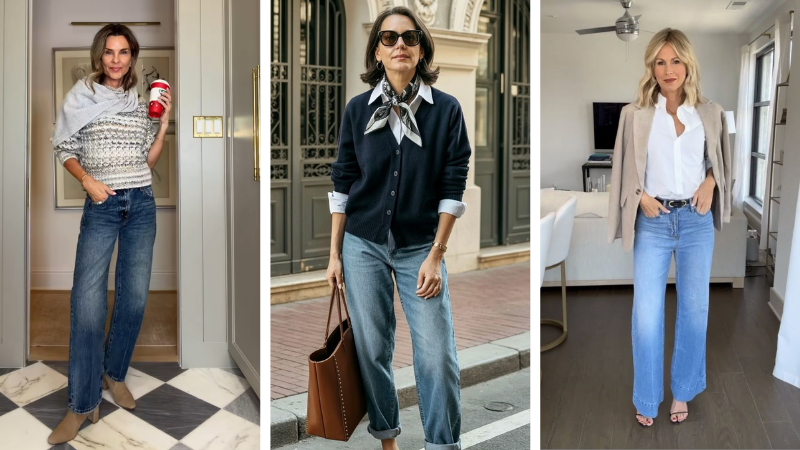
Wide-leg trousers love a more streamlined top.
A relaxed knit needs a cleaner bottom.
A long coat works best with something shorter or more fitted underneath.
Balancing proportions creates visual ease. The eye knows where to rest, and the outfit feels intentional instead of accidental.
Easy rule to remember: If one half of your outfit is relaxed, let the other half do a bit of the work.
2. Dress for visual authority, not youth

Most advice still pushes women in their 40s to “look younger.” But if you ask me, class actually comes from looking self-possessed (calm, cool, collected, confident).
Because clothing reads as “classy” when it signals control over proportions, texture, and movement.
For instance,
- Slightly structured garments (even soft ones) project authority. A knit blazer beats a floppy cardigan every time.
- Clothes that hold their shape after 10 wears look expensive; clothes that collapse look casual, no matter the brand.
- Avoid pieces that rely on stretch to fit—stretch ages a garment faster than time. A tailored trouser with movement looks more expensive than leggings that rely on stretch to fit.
Insider rule: If the garment improves your posture the moment you put it on, it’s a keeper. 😉
3. Master intentional restraint (the opposite of boring)

Classy dressing isn’t about being minimal for the sake of it — it’s about being edited. The most polished outfits usually start with several strong elements, then get refined down until only the right ones remain.
So how do you make an outfit both classy and interesting? You introduce just enough contrast to create tension, then stop.
One “wrong” element instantly elevates a look.
- A masculine shoe with a feminine dress.
- A silk skirt paired with a simple cotton tee.
- A formal coat layered over relaxed denim.
Everything else should support that moment, not fight it. When there’s one clear focal point, the outfit feels considered and that’s what reads as effortless style.
4. Mix Textures to Add Depth (Without Adding Noise)

One of the easiest ways to look polished, especially in neutral outfits, is mixing textures.
It is what keeps simple outfits from feeling flat. It adds richness without needing color, prints, or accessories.
Think:
- Soft knit with crisp cotton
- Wool trousers with a silk blouse
- Suede shoes with structured denim
- Matte fabric paired with something slightly luminous
Stylist tip: If your outfit feels boring but “technically fine,” add texture before adding color. It almost always fixes the problem.
5. Fabric behavior matters more than fabric type

People often suggest that wearing natural fibers is an easy way to look posh. But i think that’s just surface level.
What matters more:
- How fabric reacts to light (matte vs sheen)
- How it moves (fluid vs resistant)
- How it ages (does it pill, wrinkle permanently, lose color?)
A synthetic fabric that drapes beautifully and ages well will always look better than a “natural” fabric that collapses after a few wears.
6. The neckline–jawline connection (Almost No One Talks About This)

This is subtle but powerful.
Necklines visually frame your face. We all know that. But jawlines take it up a notch.
Rules stylists use:
- Softer jawlines → sharper necklines (V, square, asymmetrical)
- Strong jawlines → softer drapes or scoops
- Boat necks and crew necks demand impeccable tailoring; otherwise, they age fast
Hidden trick: If you love crew necks, size up slightly and tailor the shoulders. Most people do the opposite and miss the magic.
7. Stop chasing color seasons. Instead, use value contrast

Color analysis is trendy and definitely important, but value (light vs dark) is what actually reads polished in real life.
What matters most is how much contrast you place near your face:
- Random contrast feels messy and accidental
- High contrast (black + white) feels commanding and bold
- Low contrast (cream + taupe) feels refined and calm
8. Build outfits around neutrals first

Common advice, but often misunderstood. It doesn’t mean your wardrobe should be all white, black, and beige only. It simply means starting with a neutral base and letting it anchor the outfit.
When you add color, it should clearly work with that neutral—not fight it. A strong neutral makes even bold or playful colors look polished, while random color mixing without a neutral foundation often looks busy or unfinished.
Popular classy color combos:
- Navy + ivory
- Camel + black
- Grey + soft white
- Chocolate brown + cream (hugely underrated)
- Burgundy + brown or beige
- Grey + butter yellow
- Dark brown + olive or sky blue
- Navy + red
You get my point?
9. Shoes Set the Entire Tone (More Than Bags Ever Will)

People after their 40s tend to obsess over handbags. But I can guarantee that stylists obsess over shoes.
Shoes anchor an outfit. They signal intention instantly.
Quiet-luxury shoe details to look for:
- Thin soles (even on flats)
- Pointed toes in flats, heels, or anything
- Almond or softly squared toes
- Leather that creases gently, not sharply
Avoid anything that looks orthopedic unless it’s clearly intentional—sleek, minimal, architectural. For better comfort, find cushioned insoles in heels, flats, or whatever you’re buying.
10. Avoid Obvious Logos

I have said it a thousand times already, but I’ll say it again. Loud logos are NEVER classy.
Logos pull attention toward the brand, not you.
If you wear logos, keep them small, rare, and intentional.
11. Repetition builds signature (and class)

Classy women repeat outfits. A lot.
Why it works:
- Repetition creates identity
- Identity reads expensive
- Trend-hopping reads insecure. Screams no personal style.
But how do you make that work? Okay, so you start by finding:
- One coat silhouette
- One trouser shape
- One shoe style
Then rotate fabrics and colors—not shapes.
12. When in Doubt, Simplify

This one never fails.
- Remove one accessory
- Soften one color
- Choose the cleaner shoe
Elegance often comes from what you leave out, not what you add.
13. The Ultimate Secret: Comfort Without Apology

Not athleisure comfort—psychological comfort.
If you’re constantly adjusting, tugging, checking, or hiding, the outfit will never read classy. Ease is visible. Confidence shows up in how still you are in your clothes.
The most elegant women dress like they expect the world to adjust to them—not the other way around.
And that, more than anything, is what style in your 40s is really about.